How to officiate a wedding ceremony they’ll remember

So a friend or family member asked you to officiate their wedding. First off, congratulations, it’s a real honor and it means they trust you with one of the biggest days of their lives. It’s also completely normal to feel a little nervous right now. Most people I help have never done this before and they’re terrified of freezing up, fumbling the words, or somehow ruining the moment.
Here’s the good news. Officiating a wedding is far easier than it looks, and you don’t need to be a polished public speaker to do it beautifully. I’ve officiated weddings for over 19 years, hundreds of them at this point, and almost every ceremony I’ve performed has been for couples who wanted something modern, warm, and free of stiff religious language. This guide walks you through the entire process from the day you say yes to the moment you pronounce them married, so you can show up confident instead of guessing.
Let’s go step by step.
Step 1: Get ordained online
Before you can legally marry anyone, you need to be ordained. The good news is this takes about five minutes and it’s usually free. You can get ordained online through one of the well-known ministries like The Universal Life Church, American Marriage Ministries, or GetOrdained.org. There’s nothing to study and no test to pass. I cover the whole ordination process, including which churches are reputable and what to expect, in my full guide on how to get ordained to perform weddings. Start there, get that part handled, then come back here.
Step 2: Check your state’s legal requirements
Ordination is the easy part. The piece people skip, and the piece that actually matters legally, is making sure you meet your specific state’s rules. Most states fully recognize online ordination, but a handful have extra requirements like registering with the county clerk before the ceremony, and the laws are often old and a little strange. Don’t assume. Spend ten minutes confirming your state’s rules before the wedding so the marriage license is valid. I break down who’s legally allowed to perform a ceremony, and where the tricky states are, in can anyone officiate a wedding.
Step 3: Meet with the couple
This is where a good ceremony actually starts. Sit down with the couple, in person or on a video call, and just talk. You’re trying to learn their story and figure out the tone they want, whether that’s funny and lighthearted, emotional and heartfelt, or somewhere in between. A few things worth asking:
- How did you meet, and what’s the story you love telling people?
- Do you want it serious, funny, or a mix?
- Are there any family dynamics I should know about, like divorced parents or a recently passed loved one?
- Do you want readings, and is there anyone you’d like to include?
- Are you writing your own vows, or would you like me to provide them?
Take notes. The little details you gather here are what turn a generic ceremony into one that feels like it’s truly about them.
Step 4: Build the ceremony
This is the heart of the whole thing, and it’s where most first-time officiants feel lost. The truth is, a wedding ceremony follows a simple, reliable structure. Once you know the parts, you just fill them in. Here’s the order I’ve used at hundreds of weddings.
- Processional. The wedding party and the couple walk in. When the person getting married walks in, you ask the guests to “please rise,” and once they’ve reached the front, you invite everyone to “please be seated.” New officiants forget that second part constantly.
- Welcome and opening words. You greet everyone, thank them for being there, and set the tone. This is your moment to relax the room, and a warm or lightly funny opening does wonders.
- The couple’s story. Using what you learned in your meeting, you tell the room who these two people are and how they got here. This is almost always the part guests remember most.
- Readings. Optional, but lovely. They don’t have to be religious at all. If you want ideas that fit a modern ceremony, I’ve got a whole collection in my post on nonreligious wedding ceremonies and readings.
- The address to the couple. A short reflection on love, partnership, and what they’re promising each other. Keep it genuine and avoid clichés.
- The vows. The couple either reads their own or repeats vows after you. If they want you to provide them, this is where ready-made, modern wording saves you.
- The ring exchange. You guide them through placing the rings and saying a short line to each other. Know in advance who’s holding the rings.
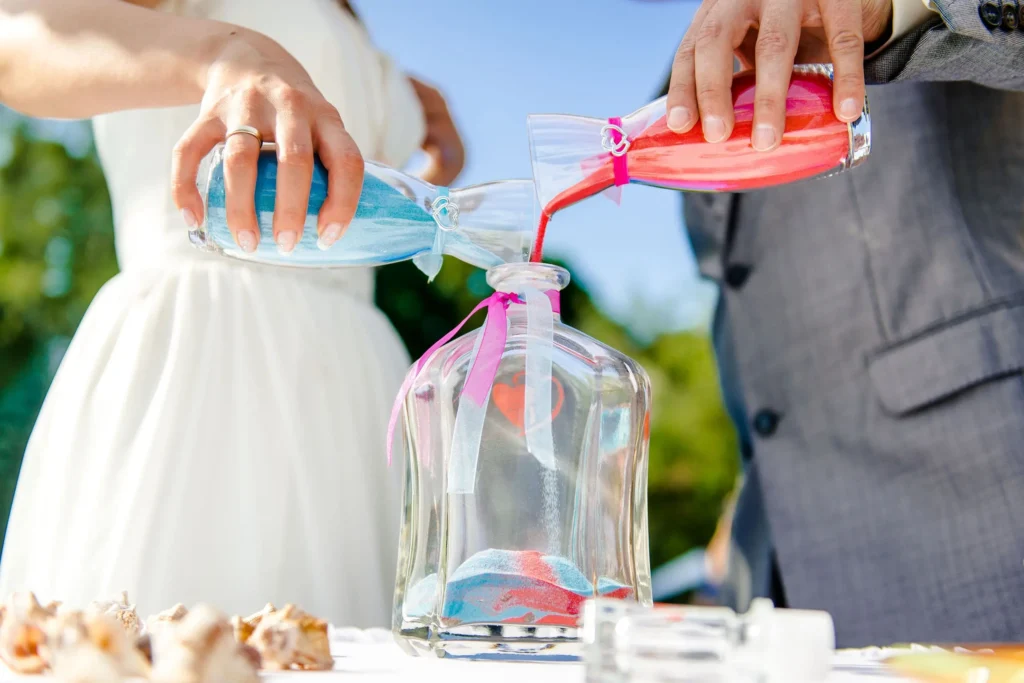
- A unity ceremony (optional). Many couples love adding a symbolic moment. If they want one, here’s how to run a unity sand ceremony, plus more wedding unity ceremony ideas.
- The pronouncement and the kiss. The big finish. You declare them married, invite the kiss, and present the newlyweds. Then comes the recessional as they walk back out together.
That’s the entire skeleton. If you’d like every one of these sections already written out in modern, nonreligious language that you can customize to the couple, that’s exactly what my Ceremony Material package is. It’s 80+ ready-to-use script combinations so you’re never staring at a blank page, and it’s the same material I use myself.
Step 5: Run the rehearsal
The rehearsal usually happens the day before, and it trips up new officiants because nobody tells them what they’re supposed to do. Your job is to help everyone know where to stand, when to walk, and what the flow looks like, so the real thing goes smoothly. A few quick pointers:
- Bring a printed copy of the ceremony and jot down everyone’s names on it, the parents, the ring holder, the coordinator, the photographer. Knowing names makes you look like a pro.
- Introduce yourself to everyone. Members of the wedding party are future couples, and vendors give referrals.
- Ask the coordinator how they like to run things. They usually have a rhythm, and following it makes you easy to work with.
I’ve put together a complete step-by-step rehearsal walkthrough, including a downloadable guide, in how to run a wedding rehearsal.
Step 6: Day-of pro tips
These are the small things that separate someone who looks nervous from someone who looks like they’ve done this a hundred times.
- Do a sound check with the DJ before the ceremony so you’re comfortable with your own volume.
- Bring mints and offer them around while everyone’s lining up. People love it.
- Ask the couple their wedding colors ahead of time and match your tie. It always gets a compliment.
- Speak slower than feels natural. Nerves make everyone rush.
- Keep a backup printed script in case your phone dies or the wind grabs your pages.
There are several more tricks I’ve picked up over the years in my post on extra tips while at the ceremony.
Common mistakes new officiants make
Most ceremony mishaps come from a short list of avoidable errors, forgetting to seat the guests, mumbling because of nerves, losing your place in the script, or running way too long. I’ve collected the full list, and how to dodge each one, in newbie ordained minister mistakes. It’s worth a read before your big day.
Frequently asked questions
Do I have to be ordained to officiate a wedding?
In almost every state, yes. Online ordination takes about five minutes and is usually free. A few states have additional registration steps, so check your local rules.
Can anyone officiate a wedding?
In most of the country, yes, as long as you’re ordained and meet your state’s requirements. A small number of states have stricter rules. Here’s a full breakdown of who can officiate a wedding.
How long should a wedding ceremony be?
Most modern ceremonies run about 10 to 20 minutes. Shorter is almost always better than longer.
What do I actually say during the ceremony?
You follow the structure above, the welcome, the couple’s story, the vows, the ring exchange, and the pronouncement. If you’d rather not write it all yourself, my Ceremony Material gives you the full wording ready to customize.
Do the vows have to be religious?
Not at all. Most of the couples I work with want a nonreligious ceremony, and there’s beautiful, modern language for every part of it.
You’ve got this
Officiating a wedding comes down to three things, getting the legal part handled, having ceremony material that sounds good, and showing up calm enough to deliver it. The first part takes five minutes. This guide covers the third. For the middle part, the actual words, that’s what I built my materials for.
If you want every section of the ceremony already written in modern, customizable language, plus video training that walks you through delivering each part with confidence, here’s what to grab next:
- Ceremony Material, 80+ modern, nonreligious script combinations ready to customize ($99)
- Video Training, learn to deliver every section like a pro ($49)
- The Bundle, scripts and video together, save $19 ($129)
You were asked because someone trusts you. With a little preparation, you’re going to give them a ceremony they’ll never forget.