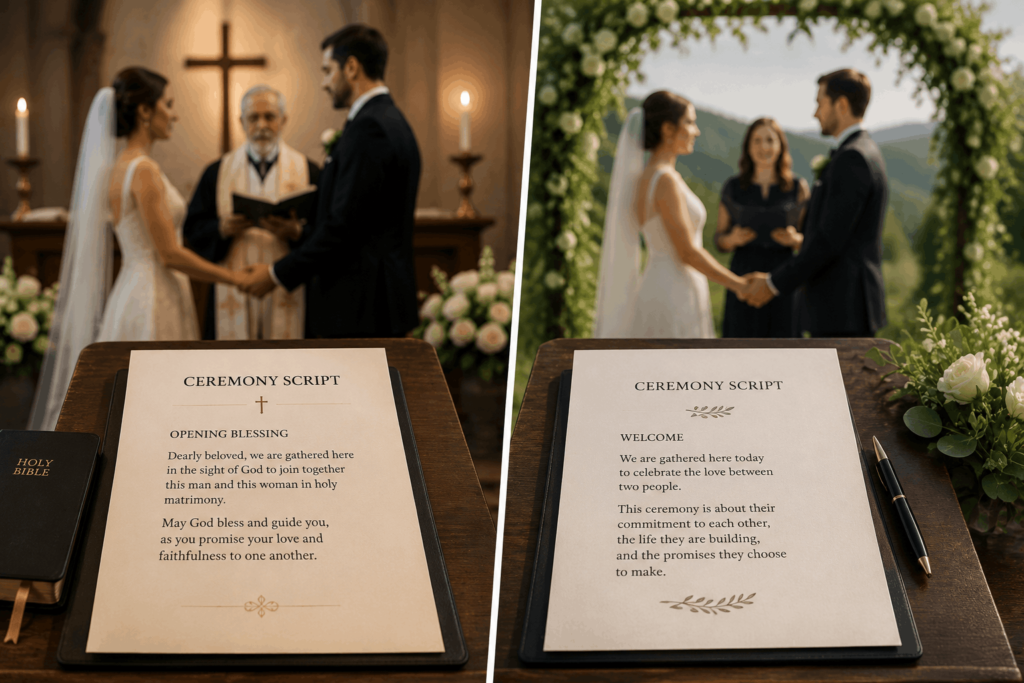
You know what you’d do. The couple wants something else.
Give them the benefit of your experience. Then remember whose wedding it is.
If you officiate enough weddings, eventually a couple will want something in their ceremony that you wouldn’t choose.
Maybe it’s a reading you don’t like. Maybe they want more religion than you’re comfortable delivering. Maybe they’ve found ceremony wording online that sounds like Shakespeare wandered into a wedding website. Or maybe you know from experience that what they’re planning probably isn’t going to work the way they imagine.
Your job isn’t to smile and agree with everything. They asked you to officiate because they trust you. Give them your honest advice.
But after you’ve given it, remember the most important part, it’s their ceremony.
Start by figuring out what you actually disagree about
Not every disagreement is the same.
Sometimes you know something the couple doesn’t because you’ve seen it play out at weddings. That’s useful experience, and you should share it.
Other times you simply don’t like what they chose. That’s different.
If a couple wants a reading that isn’t my favorite, that doesn’t automatically make it a bad reading. If they want a tradition I wouldn’t personally include, it can still be exactly right for them.
A good officiant knows the difference between “I don’t recommend this” and “I wouldn’t choose this for myself.”
When experience tells you something may not work
Explain the problem, not just your opinion
If I think something could embarrass the couple, make guests uncomfortable or create a clumsy moment, I say so.
But “I don’t like that” isn’t very helpful. Tell them why.
“You can absolutely do that. The one thing I’d think about is…”
Then explain what you’ve seen happen and offer another way to accomplish the same thing.
That keeps the conversation where it belongs. You’re helping them make a decision, not trying to win one.
When you don’t like the wording they found
Keep the meaning and make it sound like a human being
Couples sometimes send me ceremony material they found online. Some of it is beautiful. Some of it is so formal that I know I’m going to sound ridiculous reading it.
I don’t throw it away because it isn’t mine.
I look at what they liked about it and rewrite it in words I can say naturally while keeping the meaning they wanted.
That’s usually the best solution. The couple gets the sentiment they chose, and I don’t suddenly sound like a different person for three paragraphs.
When you can’t genuinely deliver a reading
A guest reader can solve the problem beautifully
If the couple loves a reading and I know I can’t read it as though I genuinely mean it, I suggest having a friend or family member read it.
That isn’t me rejecting their choice. It may actually make the moment more personal.
Just don’t solve every disagreement by adding another reader. Too many people coming up and down can break the flow of the ceremony. I generally prefer no more than two guest readers.
Religion is where you should be especially clear
Religion can mean very different things to the couple, their families and you.
If the couple asks for religious language that isn’t how you personally believe, first decide whether you can comfortably deliver it as part of their ceremony.
Often there’s an easy solution. A religious parent, grandparent or other loved one can lead a prayer or read a passage that matters to the family.
That can honor the couple’s wishes without asking you to pretend to be something you’re not.
Sometimes the answer is simply, okay
This is the part that gets easier with experience.
You give your advice. They understand it. And they still want to do it their way.
Okay.
My ego doesn’t need a vote in their wedding.
If what they’re asking is legal, safe and something I can honestly participate in, I do my best to make their choice work. I’ve been hired to help create their ceremony, not to turn it into mine.
There is a difference between disagreement and a real boundary
You don’t have to say or do absolutely anything a couple asks just because you’re the officiant.
If a request violates the law, misrepresents something important, asks you to deceive someone, or crosses a genuine personal or professional boundary, say so clearly and early.
Don’t wait until the rehearsal. Don’t hint. And don’t agree to something while secretly planning to change it during the ceremony.
“I want the ceremony to be yours, but that’s something I can’t personally do. Let’s see if there’s another way to include what matters to you.”
If there isn’t a solution and the issue is fundamental, you may not be the right officiant for that couple. It’s much better to figure that out early than create a fight close to the wedding.
The couple gets the final say more often than you do
I think of myself as the couple’s trusted servant. They asked me to officiate because they believe I’ll take care of them and do a good job.
Part of taking care of them is telling them when I think they’re heading toward a problem.
The other part is knowing when I’ve said my piece and it’s time to let it go.
Give them your experience. Give them options. Help them make the ceremony better.
Then, unless you’ve reached a real boundary, let the wedding belong to them.
Get the rehearsal guide
The rehearsal is where a lot of ceremony decisions finally become real. Enter your email and I’ll send you my printable rehearsal guide plus practical officiant tips and wedding day advice.
Download rehearsal guide
No spam. Unsubscribe anytime.
What to read next
Need ceremony material you can actually make your own?
My ceremony material gives you readings, vows, ring exchanges, unity ceremonies, pronouncements and more. Pick what fits the couple, change what needs changing and build something that sounds natural coming out of your mouth.
When you disagree with the couple
What should a wedding officiant do if they disagree with the couple?
Explain your concern and why you think it matters, then offer an alternative. If the couple understands your advice and still prefers their original choice, remember that it’s their ceremony unless the request crosses a real legal, ethical or personal boundary.
Can a wedding officiant change the couple’s ceremony wording?
You can suggest edits that make wording sound more natural, but don’t change meaningful religious, cultural or personal language without the couple’s approval.
What if an officiant is uncomfortable with a religious reading?
Talk with the couple early. One option is to have a religious family member or friend deliver the reading or prayer so the couple can include something important to them without asking the officiant to pretend to hold beliefs they don’t.
Can an officiant refuse something the couple asks for?
Yes. An officiant should not agree to something illegal, deceptive or outside a genuine personal or professional boundary. Explain the boundary clearly and early, and look for an alternative if possible.
Who gets the final say on the wedding ceremony?
The couple should control their ceremony within legal requirements and the officiant’s legitimate boundaries. The officiant’s experience is valuable, but personal preference shouldn’t be treated as a rule.